By Elspeth MacDonald – committed Northern Accelerator partner and Partnership Manager at Northumbria University.
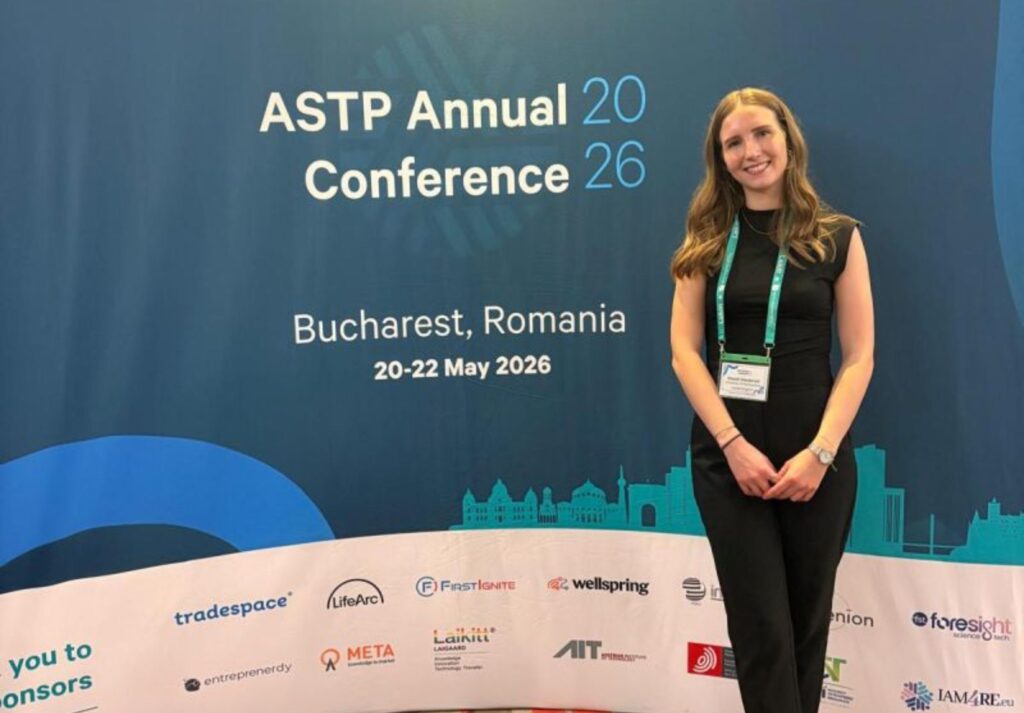
I attended the ASTP 2026 conference in Bucharest as part of a cohort of technology transfer professionals from across the UK and Europe. And four conversations in particular have stayed with me — each one connecting back, in different ways, to the work we do in the North East.
The Language
Ask a technology transfer professional from the UK what they do and they’ll usually say research commercialisation or a version of this. Ask a European counterpart and they might reach for valorisation, meaning creating value from knowledge. This difference in language points to different ideas about what we’re actually doing. Commercialisation sounds more transactional whereas valorisation asks a broader question: how does this knowledge create value, for whom, and by what route?
This distinction resonated with me given where I work. The North East has a genuinely distinctive innovation ecosystem — one where the relationship between universities and their region is key. Northern Accelerator was built on this kind of thinking: that knowledge created in the region should create value in the region. In that sense, we’ve arguably been practising valorisation without using the word.
Where are the female founders?
I attended a session titled ‘Where Are the Female Founders’ and what came up was something more specific than the familiar statistics. It was about the moments inside our own institutions where the gap gets wider.
As Technology Transfer Officers (TTOs) we have a responsibility to ensure we are supporting a wide and diverse portfolio of projects. Proactive scouting (going out to the research rather than waiting for it to come to you), came up as one of the most practical responses to this. Working across the North East university ecosystem, I’d argue it’s one of the most important habits we can build, both for pipeline quality and for making the founder community more representative. Programmes like Northern Accelerator’s Future Founders, which builds commercial confidence and entrepreneurial skills in academics, are part of that answer too. If we can reach researchers earlier, we have a much better chance of changing the picture.
The patentability of AI
The third day plenary on Patentability of AI tackled one of the liveliest questions in our field right now: can AI be an inventor? The short answer is no, not as a sole inventor. Case law across most major jurisdictions has settled that a natural person must have conceived the invention.
But the more interesting question isn’t the clear-cut case. As AI becomes more embedded in research pipelines, in drug discovery, materials science, engineering, the line between AI as a tool and AI as a genuine contributor to an invention is getting harder to draw. For those of us in technology transfer, the practical ask is already here. In every invention disclosure conversation, we need to be asking how AI was used and at what stage.
Learning on the job
I also had the privilege of presenting at ASTP this year as part of the Knowledge Stock Exchange, alongside Snehal Kadam from the University of Hull. Our session titled Foundations for a Career in Technology Transfer: Insights from the Early Years, looked at what actually shapes people in the first few years, and what the sector could do better.
The headline finding won’t surprise anyone who’s worked in TT for long, that no degree prepares you for it. The role sits at the intersection of science, business and law, and on the job learning is the primary way people develop, by shadowing colleagues, being in difficult rooms, getting comfortable with not having the answer.
Building relationships with industry partners was rated the hardest ongoing challenge regardless of experience level, which tracks with everything we see at Northern Accelerator. It never really gets easier, you just get better at it. It’s also part of why programmes like Executives into Business matter, embedding experienced business leaders alongside academic founders isn’t just good for the spinout, it’s a way of modelling what those cross-sector relationships look like in practice.
To Close
In the North East, a region that has built its innovation ecosystem through genuine collaboration and a long-term commitment to its communities, these questions feel particularly live. An odd combination of topics, perhaps. But working in Northern Accelerator, an ecosystem built on the idea that geography shouldn’t limit whose ideas get to make an impact, they all feel connected. But the same question, who gets to participate, and on whose terms, runs through all four of these conversations.